

Choosing ERP software takes more than a convincing demo. Gene Hammons, a leading business consultant specialising in ERP acquisition and deployment and Founder of Profit From ERP, talks to Joanna England about identifying the requirements that matter, involving the people who will use the system and asking suppliers to prove how their software would actually work in your business.
This interview has been edited and condensed for clarity.
Key takeaways
- An ERP software demo shows that a system can do a task, such as producing an invoice. It does not prove it can handle the way your business does that task.
- Gene Hammons starts with requirements and the processes behind them, then ranks those requirements by their effect on the business.
- The people who will use the system should attend every ERP software demo and confirm they saw how it would work in their area.
- Scorecards, supplier comparisons and reference calls keep selection focused on requirements and give the client confidence later in the project.
Why can an ERP software demo give buyers the wrong impression?
Gene: Senior people might watch a demonstration, see the system produce an invoice and assume it will work for their business. Then an accounting clerk points out that their invoices work differently. That detail can become a major problem, but you may not discover it until implementation consultants start investigating the process properly.
The demonstration has shown that the software can produce an invoice. It has not necessarily shown that it can handle yours. That is why I want to understand the business before using demonstrations to judge the options.
What do you establish before bringing suppliers into the ERP software demo discussion?
Gene: I start with requirements and the processes behind them. I want to speak to the people who work with the software and understand what they actually do. Then we can show how those processes work today and how they might change.
A company may have a hundred requirements, but they do not all carry the same value. Some could have a substantial financial impact. Others are useful improvements without the same financial impact. Ranking them changes the focus of the project and helps us choose the right software.
How do you decide which requirements deserve the most attention?
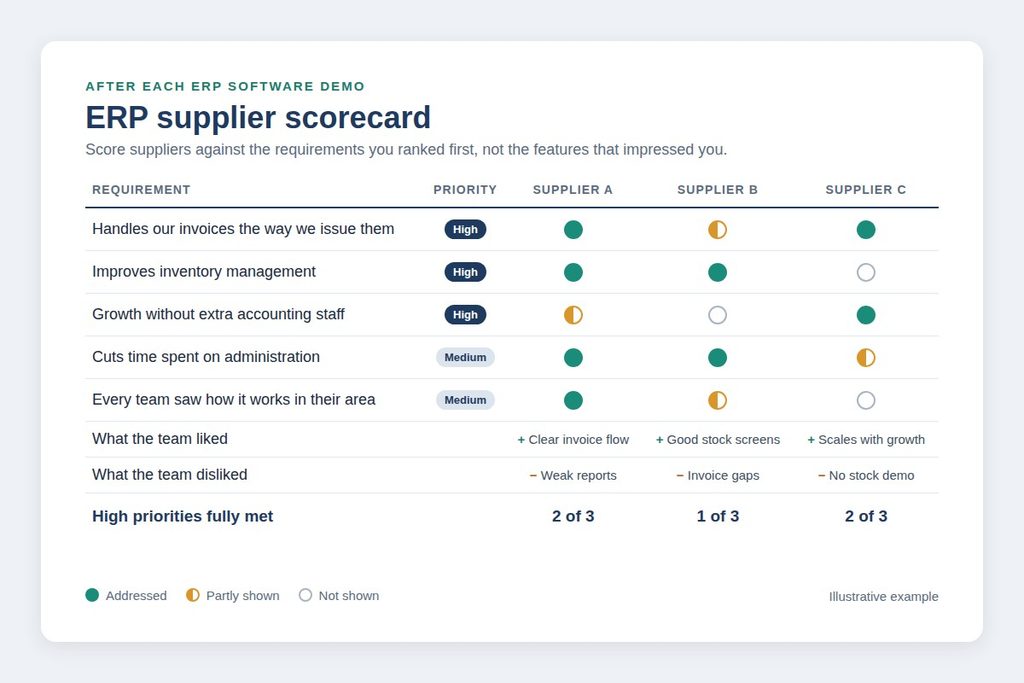
Gene: Ask what satisfying each requirement would mean for the business. Could the company grow without adding the same number of people in accounting? Could it improve inventory management? Could staff spend less time on administration and more time improving operations?
You have to connect the requirement to something that matters. Otherwise, a feature that looks impressive can receive more attention than a process that has a much bigger effect on performance. The point is to identify the important needs and keep those visible throughout selection.
Who should be involved in an ERP software demo?
Gene: The people who will use it need to be involved. After a demonstration, I ask each person whether they saw how it would work in their area. If someone in inventory did not understand a process, we arrange another session and ask the supplier to walk through it again.
That conversation does two things. It helps us test the fit, and it shows the employee that their experience matters. They become part of the decision instead of being told that new software has arrived and they now have to use it.
How do you compare suppliers without being distracted by features?
Gene: I use scorecards to bring the discussion back to requirements. What did people like? What did they dislike? How many of the important requirements did each supplier address?
I am very familiar with NetSuite, but I also consider other options when they make sense for the business. That might include Intacct or Microsoft Dynamics. There may be recently developed ERP options or we may want to bookmark against an older technology that’s native to the client’s industry. We need to understand how each option handles the important work. Attractive features are less useful if they do not address the needs that justified the project.
What does this preparation change once implementation begins?
Gene: It helps uncover difficult issues before the team is under pressure to solve them during delivery. I have seen situations where consultants discover an unusual process that wasn’t addressed in the sales process that could severely impact the project – to the point of outright failure and now the consultants are tearing their hair out behind the scenes to work out how to accommodate it, potentially through additional software development or modification.
It also gives the client more confidence in the choice. There is often a point during a project when people start to doubt the decision. Having compared the options, involved users and spoken to other customers gives them something concrete to return to. They understand why they chose the system and what they expect it to achieve.
Speaking to other customers also helps. The successful clients I studied used reference calls to build relationships with businesses that had already been through the process. That gives you another source of experience to draw on. It is part of helping the client feel comfortable with a decision that otherwise rests on information they may find difficult to judge for themselves.
ERP software demo: frequently asked questions
Gene Hammons recommends establishing your requirements and the processes behind them first, by speaking to the people who do the work. Then rank those requirements by their value to the business, so every demo is judged against what matters most.
The people who will use the system. After each demonstration, Gene asks every attendee whether they saw how the software would work in their area, and arranges another session with the supplier if they did not.
Gene uses scorecards that record what people liked, what they disliked and how many of the important requirements each supplier addressed. That keeps the comparison on requirements rather than attractive features.
Reference calls let you learn from businesses that have already been through the process. In Gene’s experience, successful clients used them to build relationships they could draw on during their own project.
Related reading
- How to choose an ERP
- What is an ERP system?
- Independent ERP consultant support for buyers
- NetSuite vs SAP compared
- ERP implementation checklist
About
Gene Hammons is an experienced ERP leader with over 400 projects. He helps CEOs, CFOs and COOs turn complex software investments into measurable strategic value. Bridging finance, operations and enterprise tech, he provides the proven methodology midsize companies need to bypass implementation pitfalls and build scalable systems that drive long-term control and profitability.
Author

Follow us on LinkedIn
New NetSuite field notes, UK pricing guidance and implementation practice, as we publish them.