
An ERP system is one piece of software that runs a business’s core operations – finance, inventory, orders, purchasing and reporting – on a single shared database. Instead of accounts in one system, stock in another and orders in a third, every department uses the same records. The ERP system updates them in real time.
That is the short version. Below, consultants who implement ERP systems for a living explain the longer version. They also cover the parts that matter when you are deciding whether you need one. No software vendor’s marketing team involved.
What does ERP stand for?
ERP stands for enterprise resource planning. The name is a relic – it dates from 1990s manufacturing software that grew out of material requirements planning (MRP). Today, almost nobody plans “enterprise resources” with it. In practice the ERP meaning is simpler: the system of record for the whole business.
What an ERP system actually does
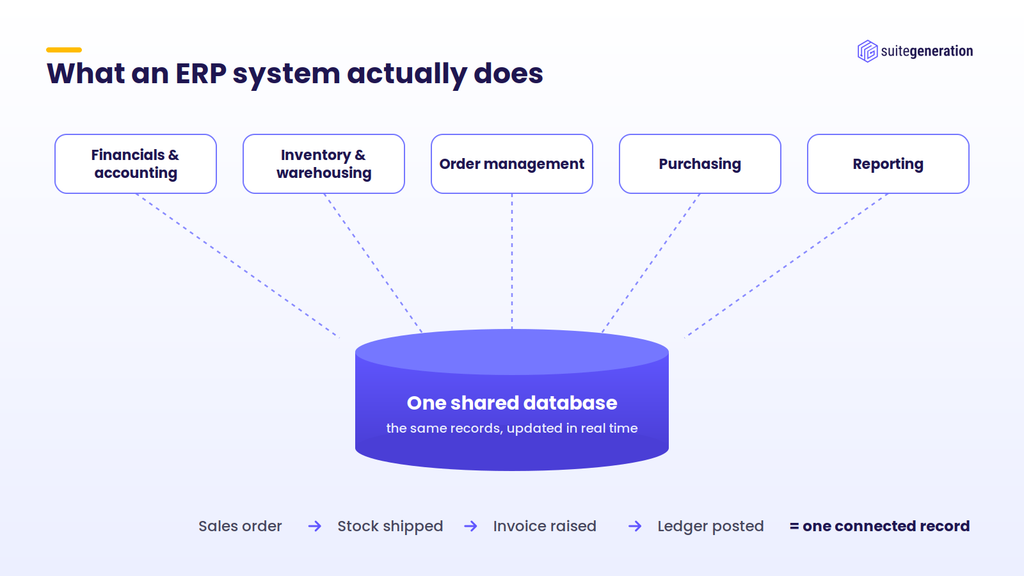
Every ERP combines modules on one database. A typical mid-market system covers financials and accounting (general ledger, payables, receivables, tax), inventory and warehousing, order management, purchasing, and reporting. Depending on your business, you add manufacturing, project accounting, subscription billing, payroll or e-commerce. But the point is not any single module – accounting software does accounting perfectly well. Instead, the ERP links a sales order, the stock you ship, the invoice you raise and the ledger entry you post in one connected record.
That single connected record lets finance teams stop reconciling spreadsheets at month end. It also keeps the stock figure on screen in line with the shelf. And it lets an auditor trace a number in the accounts back to the transaction that created it.
Examples of ERP systems
The mid-market and enterprise names you will meet most often are NetSuite, SAP S/4HANA, Microsoft Dynamics 365, Sage Intacct and Acumatica. NetSuite is Oracle’s cloud ERP, and the one we work in. Oracle’s own explainer is a fair vendor-side overview (updated August 2026). Entry systems like Xero, QuickBooks and Sage 50 are accounting packages, not ERPs. The difference is everything beyond the ledger.
Cloud ERP vs on-premise
On-premise ERP runs on servers you own and upgrade yourself. Conversely, Cloud ERP runs in the vendor’s data centre, on a subscription, with upgrades applied for you. NetSuite, for example, upgrades every customer twice a year. Most new mid-market implementations are now cloud: no hardware, faster start, and the version never falls behind. The trade-off is an ongoing subscription rather than a one-off licence, and your data living with the vendor. That is why contract and pricing terms deserve real attention before signature.
When does a business actually need an ERP system?
Not at a fixed size – when you see a specific set of symptoms. The usual ones: month-end takes weeks because numbers live in disconnected systems. Your team tracks stock, orders or projects in spreadsheets that only one person understands. You trade through more than one entity or currency, and handle consolidation manually. Or an auditor asks for a trail your current tools cannot produce. If that list feels familiar, you have probably outgrown accounting software.
If it does not, keep the accounting package. An ERP you do not need is an expensive way to slow a small business down. And if it does, the next step is choosing well. Our guide to how to choose an ERP system covers the criteria, the process and the business case.
What does an ERP system cost, and how long does it take?
For a UK mid-market business, budget for two costs: the software subscription and the implementation. The implementation is typically a project measured in months, not weeks. Its cost commonly rivals the first year’s subscription. Both vary enough with scope that ranges without context mislead. Our cost and pricing guide breaks the components down, and the implementation checklist shows what the project itself involves.
Quick answers
What does ERP stand for? Enterprise resource planning.
Is NetSuite an ERP? Yes – NetSuite is a cloud ERP system owned by Oracle.
Is ERP just accounting software? No. Accounting is one module; an ERP also runs inventory, orders, purchasing and operations on the same database.
Do small businesses need ERP? Usually not. It earns its keep once multiple systems, entities or high transaction volumes make spreadsheet glue the real cost.