
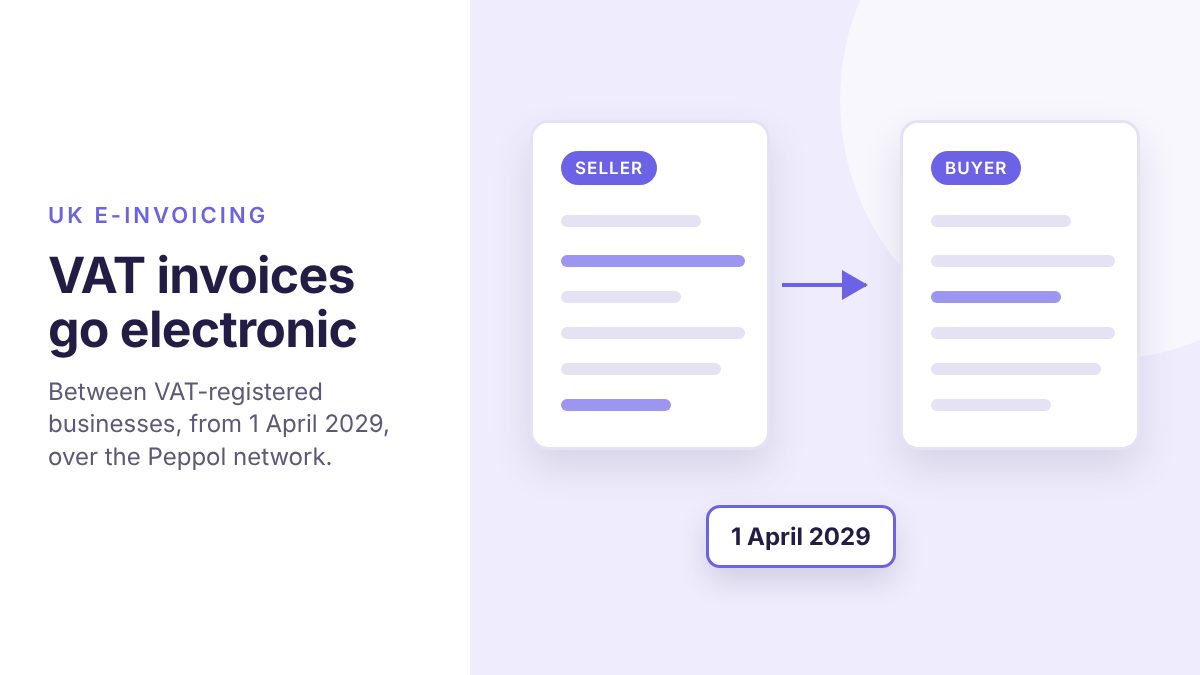
The UK has published its e-invoicing roadmap, and the date is now fixed: from 1 April 2029, VAT invoices between VAT-registered businesses will have to be e-invoices. NetSuite e-invoicing for the UK isn’t something Oracle has announced yet, so the work worth doing this year is on your own invoice data and processes rather than on software.
The roadmap arrived on 28 October 2026, alongside the Budget. It’s the first time the government has set a single start date and named the standard, which makes it the most significant UK finance story of the autumn for anyone who issues VAT invoices.
What the roadmap says
Three things stand out:
- One date. E-invoices will be required for VAT invoices from 1 April 2029. There’s no phased start by business size.
- One network. The UK will adopt Peppol as its core interoperability framework, which the government confirmed earlier in the year and has repeated here.
- Both directions. VAT-registered businesses and public bodies will need to be able to issue e-invoices and receive them.
The dates that matter
| When | What happens |
|---|---|
| Spring 2027 | Public technical consultation on UK e-invoicing standards and Access Point certification. Primary legislation expected to pass, subject to Parliament |
| October 2027 to April 2028 | Requirements confirmed: scope, exclusions, standards, business identifiers, validation rules and guidance |
| By April 2028 | Updated VAT guidance and the exemption application process |
| Spring 2028 | Software provider management requirements |
| Summer 2028 | Readiness testing with software providers |
| Winter 2028 | Infrastructure and governance arrangements operational |
| Autumn 2028 or early 2029 | Secondary legislation may not be finalised until this point |
| 1 April 2029 | E-invoicing required for VAT invoices |
Read that list from the software side and a pattern appears. The detailed standards land between late 2027 and spring 2028, and testing with providers follows in the summer of 2028. So if you’re wondering when a NetSuite localisation might appear, that’s the window to watch, rather than now.
What’s in scope, and what isn’t
In scope are taxable supplies between VAT-registered persons where a VAT invoice is required, across both the private and public sectors.
Out of scope are sales to consumers, invoices issued for non-VAT purposes and cross-border transactions. Businesses based outside the UK are treated the same as UK-based ones. Voluntary e-invoicing stays allowed, so there’s nothing stopping you moving earlier if it suits you.
Exemptions will be narrow
The government says exemptions will be tightly defined and limited. They’ll cover the digitally excluded, using the same criteria as Making Tax Digital for VAT, such as age, disability, location, religious objection or no internet access, plus a small number of technical cases where existing VAT invoicing rules conflict with e-invoicing. The application process is due by April 2028.
A second consultation, closing 20 January 2027
Published on the same day was a separate HMRC consultation on e-invoicing digital reporting. It asks whether the information created by e-invoicing should be reported to HMRC and how that might work, and HMRC says it hasn’t taken any decisions yet.
This is the one to read if you want to know where the real work lands. Mandatory invoices are a format change. Reporting to HMRC would change how your VAT process runs month to month. The consultation closes at 11:59pm on 20 January 2027 and is open to businesses, agents and software providers.
What NetSuite e-invoicing preparation looks like now
None of this needs a software project yet. It does reward a bit of tidying, though:
- Check your customer records. E-invoicing depends on identifying the other party reliably, so duplicate customers and missing registration details turn into a real problem later, rather than just an annoyance now.
- Look at how invoices leave NetSuite. If they go out as PDFs by email from several different places, that’s the process that’ll need to change.
- Count the exceptions. Manual invoices, credit notes raised outside the normal flow and anything issued from a spreadsheet are the parts that won’t translate.
- Ask your AP side the same question. You’ll need to receive e-invoices as well as issue them, and supplier invoices arriving in a structured format change how AP approval works.
- Respond to the consultation if reporting would affect you. It’s a short window, and the detail of digital reporting matters more than the mandate itself.
What we don’t know yet
Oracle hasn’t published a plan for UK Peppol support in NetSuite. That’s no surprise this far out, and Oracle does ship country-specific e-invoicing as SuiteApps once the rules firm up. The October 2026 release, for instance, added a United Arab Emirates electronic invoicing SuiteApp.
We’ll cover Oracle’s UK plans as soon as there’s something official to report. In the meantime, anyone telling you exactly how NetSuite will handle the 2029 mandate is guessing.
If you’d like help reviewing your invoice data, or the way invoices are issued today, we’re happy to take a look with you.
Sources
- GOV.UK: Roadmap for e-invoicing implementation, 28 October 2026
- GOV.UK: E-invoicing digital reporting: open consultation, 28 October 2026
- ICAS: UK Budget 2026: E-invoicing implementation roadmap, 3 November 2026
- Oracle NetSuite Help Center: Help Center update: 19 October 2026, 19 October 2026
Checked against these sources on 9 November 2026. Oracle says features, timing and availability may change.
Frequently asked questions
From 1 April 2029. The government’s roadmap, published on 28 October 2026, sets a single start date for VAT invoices between VAT-registered businesses, including public bodies, and there’s no phased start by business size.
Peppol, which the government has confirmed as the UK’s core interoperability framework for e-invoicing. The detailed technical standards follow a public consultation in spring 2027 and are due to be confirmed between October 2027 and April 2028.
Oracle hasn’t published a plan for UK Peppol support in NetSuite. It does release country-specific e-invoicing SuiteApps as the rules are confirmed, and readiness testing with software providers is scheduled for summer 2028.
Tidy up the data the mandate will depend on. Check customer records for duplicates and missing registration details, look at how invoices leave your system today, count the invoices raised outside the normal process, and think about how accounts payable would receive structured invoices.
Related reading
- What is the month-end close process?
- NetSuite ROI: how to build a business case your CFO will sign
- NetSuite Next comes to the UK: what changes for your account
- AI and intelligent automation in NetSuite
Author

Follow us on LinkedIn
New NetSuite field notes, UK pricing guidance and implementation practice, as we publish them.