
The month-end close process is the set of steps a finance team works through to finalise a month’s numbers – cutoffs, reconciliations, accruals and reporting. Until the team completes the close, the P&L and balance sheet are provisional. After the close, they are the version the board, the auditors and HMRC see.
This guide covers the steps, the timescales UK mid-market teams should expect, and where closes usually stall. It comes from consultants who redesign close processes inside NetSuite for a living. Oracle’s overview of the financial close is a fair primer (checked September 2026); this is the practitioner version.
The month-end close process, step by step
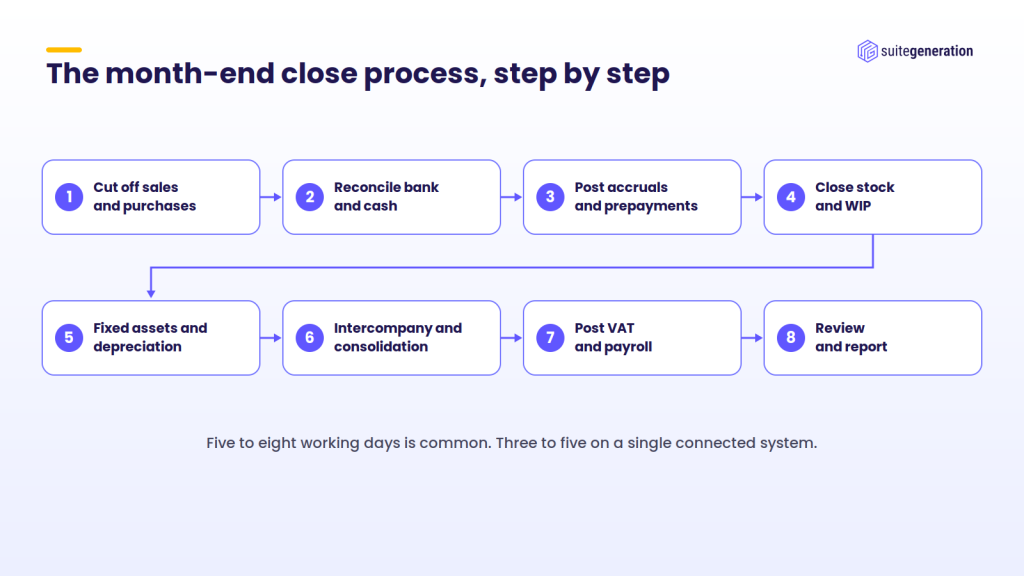
Cut off sales and purchases. Pick a cutoff, communicate it, and hold it. Late invoices are the single most common reason a close reopens.
Reconcile bank and cash. Every account, every month. With bank feeds and auto-matching this is hours, not days.
Post accruals and prepayments. Accrue costs you have consumed but the supplier has not yet billed. Release prepayments on schedule, not by memory.
Close stock and WIP. Count or cycle-count, value the movements, and investigate write-offs before they hit the P&L unexplained.
Run fixed assets and depreciation. Capitalise additions, then run the depreciation cycle and retire disposals.
Settle intercompany and consolidate. Match intercompany balances, eliminate them, and translate foreign entities. In multi-entity groups this is where most of the time goes.
Post VAT and payroll. Reconcile the VAT control account to the return. Likewise, tie the payroll journals to the payroll reports.
Review and report. A flux review – this month against last month and budget, with explanations for the gaps – catches errors the reconciliations missed. Then issue the pack.
How long should the close take?
A UK mid-market business commonly takes five to eight working days to complete the close. However, a department managing a well-run close on a single connected system finishes in three to five. Longer than ten is a symptom, not a workload. This usually means the team rebuilds data by hand that the systems should already agree on.
Measure the repeatable month, not the record month. A close calendar with a named owner and a target day for every task improves the timescale more than any single piece of software. Review it every month.
Why closes drag
The same patterns repeat across businesses. First, teams keep numbers in disconnected systems, so they start the close with exports and lookups. Meanwhile, they often manage reconciliations in spreadsheets that only one person understands. Intercompany balances never quite agree, so two teams burn days resolving differences that should net to zero. Finally, teams only start the close when the month ends, so they tackle ten days of work in a lump instead of spreading it throughout the month. That makes reconciling continuously through the month the cheapest fix on this list.
A structural change delivers the deeper fix. When your system connects the sales order, the stock movement, the invoice and the ledger entry in one connected record, it eliminates most of the close’s reconciliation work. Our explainer on what an ERP system is [link this phrase to the ERP post in WP] makes that argument in full. And close design belongs inside the implementation, not after it: our NetSuite implementation approach treats the close calendar as a deliverable of the project, not an afterthought.
Shortening the month-end close process in NetSuite
NetSuite gives you most of the machinery. First, the period close checklist enforces task order and sign-off by period. Next, bank feeds and intelligent transaction matching take the manual work out of step two. Meanwhile, bill capture and approval workflows stop the late-invoice problem at the door. Finally, saved searches highlight exceptions – unposted transactions, unmatched intercompany lines, stuck approvals – so your team spots them daily instead of discovering them on day six.
Most teams use a fraction of this because nobody ever designed the close. Instead, it accumulated. If your close sits at ten days, no one has time to fix the machine while operating it. On-demand NetSuite support exists for exactly that shape of problem.
Quick answers
What is the month-end close process? The steps a finance team follows to finalise a month’s accounts: cutoffs, reconciliations, accruals, consolidation and reporting.
How long should month-end close take? Five to eight working days is common for UK mid-market teams. However, three to five is achievable on a single connected system.
What is a soft close? A lighter close – key reconciliations and accruals only – for months that do not need full precision, keeping the hard close for quarter ends.
Does an ERP speed up the close? Materially, in the right conditions – one shared database removes the cross-system reconciliation that eats most close time. The system alone does not; the close still needs an owner and a calendar.